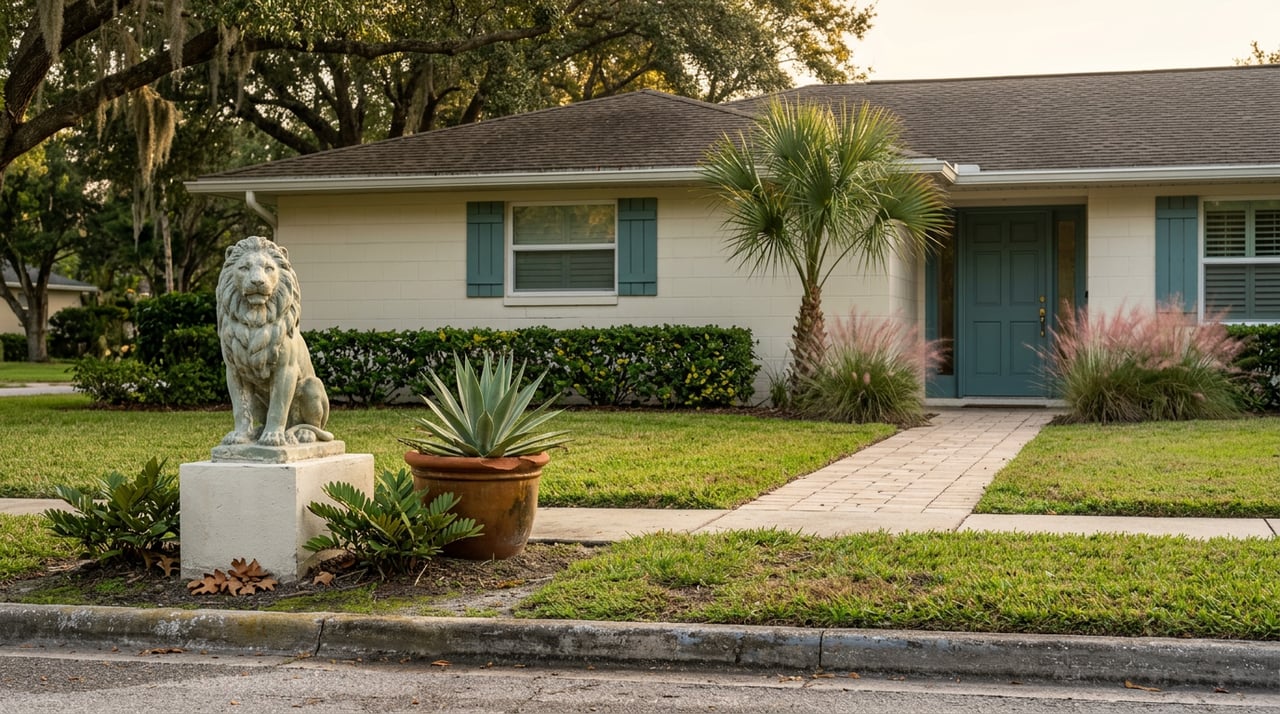
Snell Isle's 140 Statues Have No Official Caretaker. Residents Do the Job Instead
August 13, 2026
August 13, 2026
In most years, a spring email lands in Snell Isle inboxes with a request you won't find in any other St. Petersburg neighborhood: come clean a panther. Empty the dirt out of a planter. Maybe pick up a paintbrush for a lion that's gone chalky after another humid summer. The Snell Isle Property Owners Association sends it, inviting residents to help care for the neighborhood's statuary and planters.
The upkeep depends on volunteers who respond to the appeal.
Ride around the island and the statues start to blur together after the third or fourth one. A lion here. A griffin at the next corner. Something feline crouched near a driveway that's been there so long it reads as landscaping rather than sculpture. SIPOA's own volunteer alert puts a number on what most residents experience as background scenery: "you can't help but notice our lovely statuary - all 140 of them." Add 29 planters scattered through the neighborhood, and you have close to 170 pieces of concrete and stone that somebody has to keep from falling apart.
There is no city crew assigned to this. There is no line item in a municipal budget for panther upkeep. The organization asking for help is a voluntary organization dedicated to the care and beautification of the Snell Isle community, and it invites residents to help care for the statuary.
The statues exist because one developer decided a subdivision needed a personality. C. Perry Snell bought the mangrove flats that would become the island on April 4, 1911, for $2,000. When the development finally opened to buyers in October 1925, only 39 of its 275 acres were above the high tide line. Most of what you drive on today was fill dirt hauled in from Tampa.
Snell wasn't selling swampland with a nice view. He was selling an idea, and according to a detailed local history from Green Bench Monthly, Snell wanted his upscale development to be "the pearl of Pinellas." To make that case, he erected statues and sculptures, including concrete renderings of jungle animals and griffins at street intersections, and some were imported from Europe and others manufactured in the United States. It's an odd move for a Florida real estate developer in the 1920s, closer to building a private zoo than staging a subdivision, and it's the reason a peninsula with no zoning for tourism still gets treated like a walking gallery by people who've lived here twenty years.
By local accounts, the original European statuary alone cost Snell more than a million dollars in 1920s money by the time it was shipped, placed, and later restored around the Park Plaza. Whatever the real number was, it tells you this was never meant to be disposable decoration. It was a founding investment, on par with the roads and the bridge.
The association's origins offer useful context for its current volunteer model. SIPOA wasn't formed to manage a statue collection. The Snell Isle Property Owners Association was first organized in 1936 when there were fewer than 20 homes on the island. It has grown alongside the neighborhood, but its funding structure never changed into something mandatory. Dues for joining the Association begin at $50 and increase from there, with many residents paying $100, $250, $500, or $1,000 or more annually.
That's not an HOA assessment. Nobody is billed. Nobody can be fined for skipping it. Which means the statues Snell spent a small fortune importing from Europe a century ago are now maintained through the same voluntary system that funds the neighborhood's holiday party and its summer social. SIPOA runs on volunteers, and it relies on the time and efforts of residents to support the numerous events and activities held within the neighborhood throughout the year.
That volunteer model is put into practice through the spring appeal.
The spring appeal isn't symbolic. SIPOA spells out the job in practical terms: empty the planters of leggy plants and dirt, clean them up with a little bleach and water and a thorough rinse, then repaint if necessary and replant. The organization prioritizes the 29 planters first, since those need seasonal attention most urgently, but the invitation extends to the statuary itself.
You don't need to live directly beside a statue to help. Whether you live near one of these planters or not, residents are asked to help by "adopting" one or more, and the plan is to replant them with succulents that need minimal upkeep beyond occasional watering. It is, in practice, a low-commitment ask. A few hours a year, maybe less if you split the work with a neighbor.
If you want to see the collection for yourself before deciding whether a particular corner needs your attention, a few spots concentrate the most pieces:
None of this requires a special occasion. It's a Tuesday evening walk, reframed.
Snell Isle's statuary is a distinctive part of the neighborhood's history, and its upkeep depends on volunteer participation. SIPOA's spring appeal invites residents to help care for the statues and planters.
The number 140 highlights the scale of the statuary collection and the role of resident volunteers in caring for it.
If you're curious about what else SIPOA has planned this year, back issues of its newsletter, The Panther, are the place to look, and joining costs less than a dinner out. For residents thinking further ahead, whether that means understanding what a home near the Park Plaza is worth today or simply staying current on what's changing across the island, Becky McConnell tracks Snell Isle closely and offers a free Instant Home Valuation for anyone who wants a clearer picture of where their own corner of the neighborhood stands.
This article is general information, not legal, tax or financial advice. Consult a qualified professional about your situation.
Stay up to date on the latest real estate trends.
In real estate, every decision matters. With Becky’s strategic approach, you’ll have the insights and expertise needed to make informed moves that maximize your investment and achieve your goals in St. Pete’s dynamic market.